Skin age is a measure of how old your skin appears relative to others in your age group, which may be older or younger than your actual chronological age. It reflects the cumulative condition of your skin based on factors like texture, pigmentation, and elasticity. The following sections unpack how skin age is assessed, what drives it, and what can genuinely be done to improve it.
How is skin age different from chronological age?
Chronological age is simply how many years you have been alive. Skin age is a biological assessment of how your skin is actually functioning and appearing relative to others in your age group. Two people who are both 50 years old can have dramatically different skin ages depending on their genetics, lifestyle, and sun exposure history.
Chronological age advances at the same rate for everyone. Biological skin age does not. It reflects the real-world condition of your skin, including moisture retention, elasticity, and the degree of visible damage accumulated over time. Someone who has spent years in a high-UV environment, like coastal South Carolina, may show skin characteristics more typical of someone a decade older. Conversely, someone with good protective habits and genetics may show skin that looks younger than their years.
The practical significance is that skin age gives you a more actionable picture of where your skin actually stands. Knowing your chronological age tells you nothing about what your skin needs. Knowing your biological skin age does.
How is skin age measured?
Skin age is assessed by evaluating multiple visible markers of skin health and comparing those findings against age-matched norms from a large reference population. Key markers include skin texture, pore size, pigmentation, UV-related features, redness, and visible fine lines. The result is a comparison that places your skin in context relative to people of a similar age.
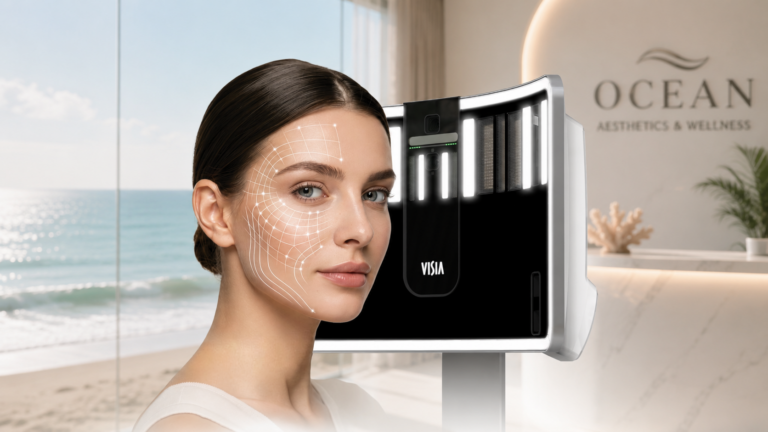
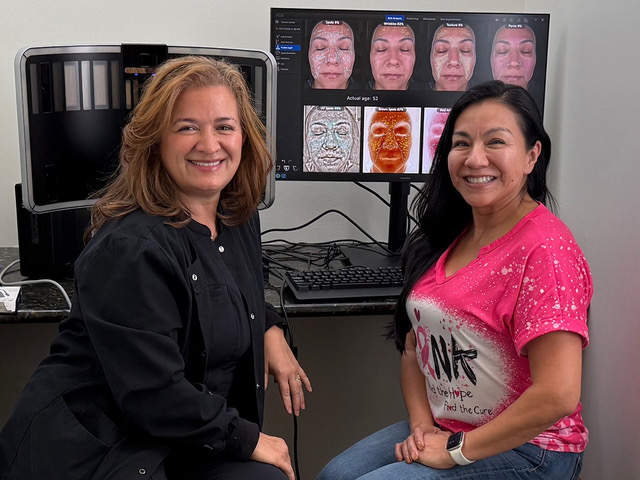
Clinical skin analysis has advanced significantly beyond what a visual assessment can offer. Advanced imaging systems like VISIA®, a complexion analysis platform, capture multi-spectral images of the skin at different wavelengths simultaneously. This allows clinicians to evaluate not just what is visible on the surface, but also subsurface pigmentation, UV-related features that have not yet emerged as visible spots, and vascular patterns that indicate redness.
The VISIA® system compares your visible skin features against a database of profiles from people of similar age, giving you a baseline you can track over time. That comparison produces an objective reference point, one that reflects how your skin measures up across the dimensions evaluated — spots, wrinkles, texture, pores, UV-related features, and redness. It does not measure collagen, diagnose conditions, or choose treatments. At Ocean Aesthetics & Wellness, this process is built into every consultation through our VISIA skin analysis in Hilton Head Island, which gives patients a data-supported baseline before any treatment recommendation is made.
A skin analysis conducted this way is meaningfully different from a basic skin assessment. It produces consistent, visual data that can be revisited over time to track progress.
What factors make skin age faster than it should?
The primary driver of accelerated skin aging is cumulative UV exposure. Sun damage disrupts pigmentation and degrades the structural proteins that keep skin firm and even. Beyond UV, smoking, chronic stress, poor sleep, a diet high in processed foods, and inadequate hydration all contribute to skin aging at a faster rate than genetics alone would produce.
For patients in coastal environments, UV exposure is often the most significant factor and frequently the most underestimated one. UV damage accumulates over decades, and much of it is invisible until it surfaces as hyperpigmentation, uneven texture, or structural changes in the skin. Advanced imaging regularly reveals UV-related features in patients who have no visible spots yet, because the damage exists in deeper skin layers before it becomes apparent on the surface.
Other factors that accelerate biological skin age include:
- Repetitive facial muscle movement over time, which contributes to expression lines and changes in facial structure
- Collagen loss, which begins in the mid-20s and accelerates after menopause, reducing skin firmness and elasticity — learn more about the signs of collagen loss in your face and what they look like
- Glycation, a process in which sugar molecules bind to collagen fibers and make them rigid and less functional
- Pollution and environmental oxidative stress, which damage the skin barrier and accelerate cellular aging
- Rapid weight changes, which can affect skin laxity and volume distribution in the face
The combination of these factors is cumulative. No single element ages skin in isolation, and addressing skin age effectively requires understanding which factors have been most active in your specific case.
Can you reverse skin age or only slow it down?
You can meaningfully reduce biological skin age, not just slow its progression. Targeted treatments can stimulate new collagen production, improve skin texture, reduce pigmentation, and restore structural support — all of which shift measurable skin markers in a younger direction. The degree of improvement depends on where you start, what treatments are used, and how consistently they are applied.
The distinction between reversing and slowing is worth clarifying. Chronological aging cannot be reversed. The biological markers that define skin age, however, are not fixed. Pigmentation can be reduced. Skin texture can be refined. These are measurable changes, and when they occur, your skin analysis results can reflect that improvement over time. Knowing how to approach tracking whether treatments are working is an important part of any long-term plan.
That said, results are not permanent without ongoing care. Skin continues to age biologically, and environmental factors continue to act on it. The most realistic framing is that effective treatment can bring your skin to a younger biological state, and a consistent maintenance approach can keep it there. The goal is not a one-time fix but a sustainable improvement that holds over time.
What treatments are most effective at reducing skin age?
The most effective treatments for reducing skin age are those that address the underlying biological mechanisms driving it — specifically skin laxity, UV damage, and surface texture. Non-invasive energy-based treatments have become the clinical standard for achieving measurable improvements without surgery or significant downtime.
At Ocean Aesthetics & Wellness, the treatments most directly linked to improving biological skin age markers include:
- EMFACE®, which uses synchronized radiofrequency and HIFES™ electromagnetic energy to tone facial muscles and tighten the skin simultaneously. This addresses the structural dimension of skin aging, including laxity and loss of facial definition, without needles or downtime. Learn more about EmFace facial muscle toning treatments and how they support skin rejuvenation.
- EXION®, a platform that delivers radiofrequency ultrasound and RF microneedling to stimulate collagen production beneath the skin’s surface. It is particularly effective for patients for whom skin quality, texture refinement, and deeper structural restoration are the primary concern. Explore Exion radiofrequency skin restoration therapy for a closer look at how this technology works.
- Laser Skin Resurfacing using the ReNew Waterlase laser, which targets surface-level concerns including pigmentation, sun damage, uneven texture, and acne scarring with precision. Our laser skin resurfacing treatment options address a range of surface-level skin concerns effectively.
For many patients, the most effective approach combines treatments that work at different layers simultaneously. Surface pigmentation and texture may respond best to laser resurfacing, while deeper structural concerns and muscle tone respond better to EMFACE® or EXION®. A structured treatment plan that sequences these appropriately, based on what your skin analysis actually reveals, is more likely to produce meaningful improvements than any single treatment used in isolation. Our signature rejuvenation pathways for skin health are designed to guide patients through exactly this kind of personalized, multi-layered approach.
If you want to understand where your skin stands before committing to any treatment, the right starting point is an objective baseline. A complimentary consultation at Ocean Aesthetics & Wellness in Hilton Head Island takes about 20 minutes and includes a full VISIA skin analysis, giving you a clear picture of your visible skin markers with no obligation to proceed. To get started, learn more about how to get a complimentary skin analysis, or go ahead and book your complimentary skin analysis when you are ready.